

Against the backdrop of the booming aesthetic medicine industry, polylactic acid (PLA) facial fillers, as core products for facial contour remodeling and aging correction, are ushering in unprecedented market opportunities. However, opportunities are accompanied by challenges. As high-risk injectable medical devices, PLA facial fillers involve interdisciplinary technical review covering material science, biocompatibility, clinical evaluation and long-term safety assessment. Compared with conventional medical devices, such products feature high technical barriers, stringent compliance requirements and lengthy review cycles, which have become critical bottlenecks for the industrialization and marketization of innovative aesthetic technologies.
The Center for Medical Device Evaluation (CMDE) of the NMPA has continuously strengthened scientific review principles for such products, emphasizing full lifecycle quality control and real-world evidence support. Faced with a complex regulatory framework and dynamically updated technical standards, enterprises relying solely on internal experience often struggle to advance registration efficiently. Insufficient early-stage planning may lead to major supplementary review requirements at later stages and further delay product market access.
Supported by an experienced expert team specializing in aesthetic medical device registration, this article systematically sorts out the full-cycle key difficulties of PLA facial filler registration, including raw material quality control, formulation and process validation, biological evaluation, clinical trial design, and registration dossier compilation. Combined with the latest review cases and common deficiencies in supplementary feedback, this article delivers targeted guidance for manufacturers. Beyond regulatory interpretation, this paper translates professional review logic into actionable registration strategies, helping innovative products advance steadily on a compliant track and enabling safe and effective aesthetic medical technologies to benefit consumers at an early date.
In accordance with the basic classification criteria specified in the Medical Device Classification Catalog, polylactic acid facial dermal fillers fall under Code 13 Non-active Implantable Devices - 09 Plastic and General Surgical Implants - 02 Injectable Fillers for Plastic Surgery (13-09-02). Per Announcement No.30 issued by NMPA in March 2022 regarding partial revision of the Medical Device Classification Catalog, polylactic acid facial fillers are categorized as high-risk Class III medical devices.
| 13 Non-active Implantable Devices |
| 09 Plastic and General Surgical Implants |
| 02 Injectable Fillers for Plastic Surgery |
| Generally composed of syringes prefilled with filler materials. |
| Intended for injection into dermis and/or subcutaneous tissue to augment tissue volume. |
| Cross-linked sodium hyaluronate gel for injection, sodium hyaluronate gel for injection, collagen implant, PLLA injectable filler, recombinant type III humanized collagen lyophilized fiber |
| Class III |
| 13 Non-active Implantable Devices |
| 09 Plastic and General Surgical Implants |
| 02 Injectable Materials for Aesthetic Plastic Surgery |
| No revision |
| No revision |
| No revision |
| Class III |
In 2024, CMDE issued Supplementary Version 2024 of Recommended Clinical Evaluation Routes for Products under Medical Device Classification Catalog (Announcement No.11, 2024), which stipulates that PLLA facial fillers shall in principle adopt clinical trial route for clinical evaluation, imposing stricter compliance requirements on such implant products.
| 18 | 19 |
| 13-09-02 | 13-09-11 |
| Plastic and General Surgical Implants | Plastic and General Surgical Implants |
| Injectable Fillers for Plastic Surgery | Implantable Threads for Plastic Surgery |
| Generally supplied as pre-filled syringes or bottled formulations mainly consisting of sodium hyaluronate; products shall contain no ingredients with pharmacological, immunological or metabolic effects. | Manufactured from absorbable or non-absorbable polymers, available with or without attached needles. |
| For temporary improvement of dry skin and dull complexion in adult patients | Implanted into facial tissue to lift ptotic soft tissue and correct wrinkles. |
| Sodium Hyaluronate Solution for Injection | Facial implant thread, facial lifting thread, facial cone lifting thread |
| Class III | Class III |
| Clinical Trial Required | Clinical Trial Required |
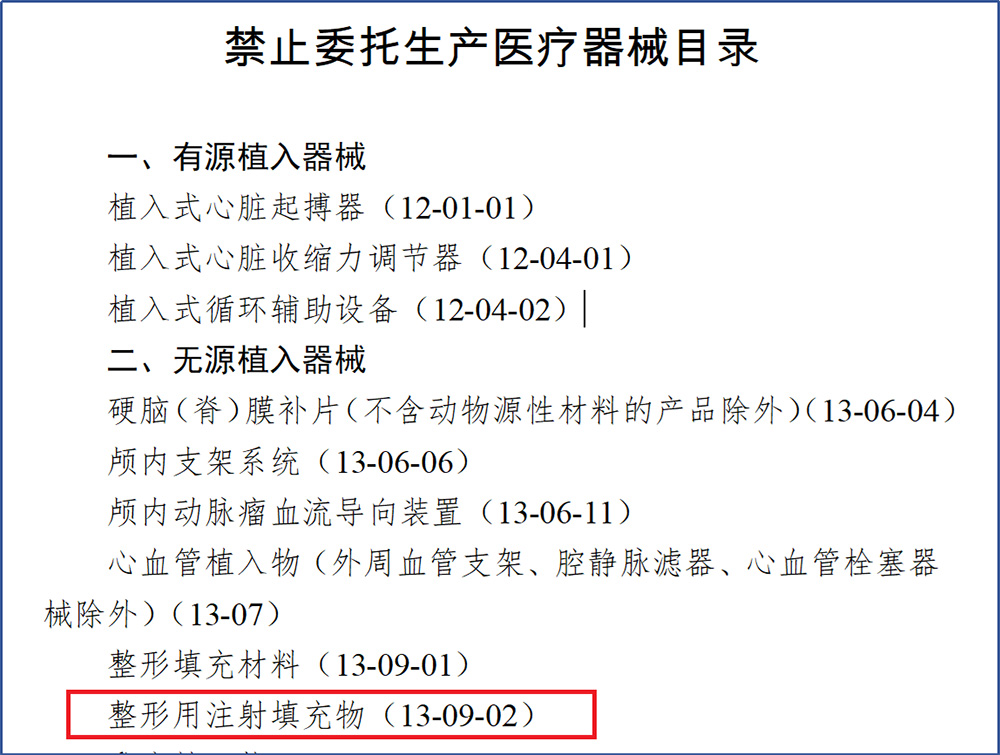
Special attention shall be paid that Injectable Fillers for Plastic Surgery (13-09-02) are listed in the Catalog of Medical Devices Prohibited from Entrusted Production published by NMPA in March 2022. Accordingly, PLLA facial fillers are forbidden from outsourced manufacturing and must be produced in-house by registration holders, which raises higher requirements on manufacturers' internal production capacity.
Safety and efficacy serve as the irreplaceable cornerstone for products within the medical aesthetic industry. Adequate preclinical research constitutes core scientific evidence for clinical trial application submission and subsequent product registration. Such activities comply with regulatory requirements and represent a solemn commitment to every end user pursuing cosmetic improvement.
Products shall undergo rigorous scientific assessment prior to human administration. Manufacturers shall conduct standardized animal studies to fully verify product safety and effectiveness.
Clear research objectives: core assessments cover in-vivo degradation profile, histocompatibility, potential inflammatory response and neocollagenesis efficacy. Key generated data provide indispensable scientific support for human risk prediction and rational formulation of clinical injection protocols including injection depth and dosage.
Full-process quality control: all trials shall be completed at qualified and certified research institutions. Every procedure from protocol drafting, trial execution, data collection to final reporting shall be authentic, scientifically sound, reliable and fully traceable to build credible evidence chain.
Product safety is embedded in design. In strict accordance with ISO‑14971 international standard, risk management shall be practically implemented throughout daily R&D activities instead of remaining as a nominal concept from the early development stage.
Risk identification & analysis: systematic hazard screening and evaluation covering full product lifecycle including product design, raw material selection, manufacturing procedures and clinical application.
Risk mitigation: proactive control measures shall be formulated and enforced against identified hazards. The finalized Risk Management Report acts as the key document for product safety assurance and mandatory dossier for registration submission.
Sufficient investment and rigorous implementation during preclinical research lay solid foundations for safe, effective and stable clinical application, enabling each injection supported by solid scientific evidence and safety commitment.
In 2024, the Center for Medical Device Evaluation, NMPA issued the Recommended Clinical Evaluation Pathways for Products in the Medical Device Classification Catalogue (2024 Supplement) (Announcement No.11 of 2024), specifying that clinical evaluation for PLA facial fillers shall in principle be completed via clinical trials.
Back in December 2023, NMPA released the Guideline for Registration Review of Clinical Trials for Facial Injectable Dermal Fillers (Draft for Comments), which sets forth specific design requirements for clinical trials of polylactic acid facial fillers.
Beyond core trial components including prospective design and randomized controlled superiority trial layout, extended trial duration and follow-up periods are required to generate sufficient efficacy and safety evidence due to the inherent product characteristics of PLA facial fillers. The trial cycle shall cover the labeled duration of clinical effect and take the material degradation profile into full consideration. For PLA fillers featuring prolonged degradation cycles, the safety assessment endpoint is recommended to last until the material reaches stable degradation status, generally no less than one year.
| Common Risk Points Prone to Supplementary Document Requests |
|---|
The risk management report fails to cover the full product lifecycle; risk analysis omits links ranging from raw materials, manufacturing processes and sterilization to clinical administration and post-use disposal.Insufficient supporting documentation for control specifications of critical raw materials and key parameters plus validation records of core manufacturing techniques including membrane emulsification and aseptic filling, making batch-to-batch consistency unverifiable.Only accelerated stability data is submitted without adequate real-time long-term stability data to confirm constant physicochemical properties such as particle size and viscosity as well as sterility during shelf-life storage.Original raw data and detailed analytical records cannot be traced for biocompatibility tests including cytotoxicity, sensitization and intracutaneous reactivity.Insufficient clinical follow-up duration (less than 12 months for instance) cannot support adequate evaluation of long-term efficacy and delayed adverse reactions such as nodules and granulomas.Lack of detailed data and scientific interpretation regarding incidence, root cause analysis and countermeasures for common post-injection reactions (pain, bruising, edema) and severe complications like nodules. |
| Common Risk Points Prone to Supplementary Document Requests |
No sufficient clinical data or literature evidence to confirm contraindication or cautious use for patients with keloid diathesis, autoimmune diseases or previous permanent filler implantation at target injection sites.Undefined specification for reconstitution solvent type, solvent volume, standing duration and post-reconstitution expiry limit (e.g., within 72 hours), bringing potential nodule risks induced by improper reconstitution.Missing defined recommended injection plane (e.g., supraperiosteal layer) and critical operational reminders including prohibition of intravascular injection, avoidance of forced injection and mandatory post-injection massage, which raises risks of vascular embolism and nodule formation.Discrepancy between claimed intended use (applicable facial sites and indications) and clinical trial evidence with product claims exceeding the scope validated by clinical data. |
Based on practical regulatory review experience, the dominant registration obstacles for PLLA facial fillers rarely originate from isolated failed lab tests but incomplete or inadequate cross-linked evidence across all submitted dossiers. Reviewers focus intensively on raw material traceability control, production process management, long-term stability validation and ongoing post-market risk management to verify manufacturers' capacity to sustain consistent product quality after commercial launch.
As Class III high-risk medical devices, PLA facial fillers impose comprehensive tests on manufacturers' technical capacity, compliance management and clinical evidence throughout the whole registration process.
Prioritize classification confirmation: Confirm the classification code 13-09-02 and abandon any speculative attempt to register medical device products as cosmetics.
Build solid clinical evidence base: Strictly comply with the Guideline for Registration Review of Clinical Trials for Facial Injectable Dermal Fillers. Superiority trial design, blind implementation and long-term follow-up are all indispensable.
Form closed-loop production control: Outsourced manufacturing is prohibited; enterprises shall establish independent quality management systems to guarantee product safety from the source.
Manufacturers shall introduce professional registration teams at the early product design phase and synchronize R&D with registration work. Regulatory requirements shall be taken as the benchmark across the whole lifecycle from product design to commercial launch, so as to prevent registration failure caused by careless omissions in quality management and production verification at later stages.
Specializing in medical device clinical trial service, stability & efficacy evaluation, registration dossier compilation and QMS docking, Deda Medical delivers full-spectrum customized services covering preliminary project feasibility analysis, protocol formulation, clinical trial support and final dossier consolidation.
Against the backdrop of tightened supervision across the aesthetic medical industry, embedding compliance into every link of R&D, clinical research, production and distribution is the key to steady progress in PLA facial filler registration.
Technological innovation is encouraged while the safety red line must never be crossed; market expansion is feasible while compliance foundation shall always remain unshaken. Deda Medical accompanies you toward successful registration.