

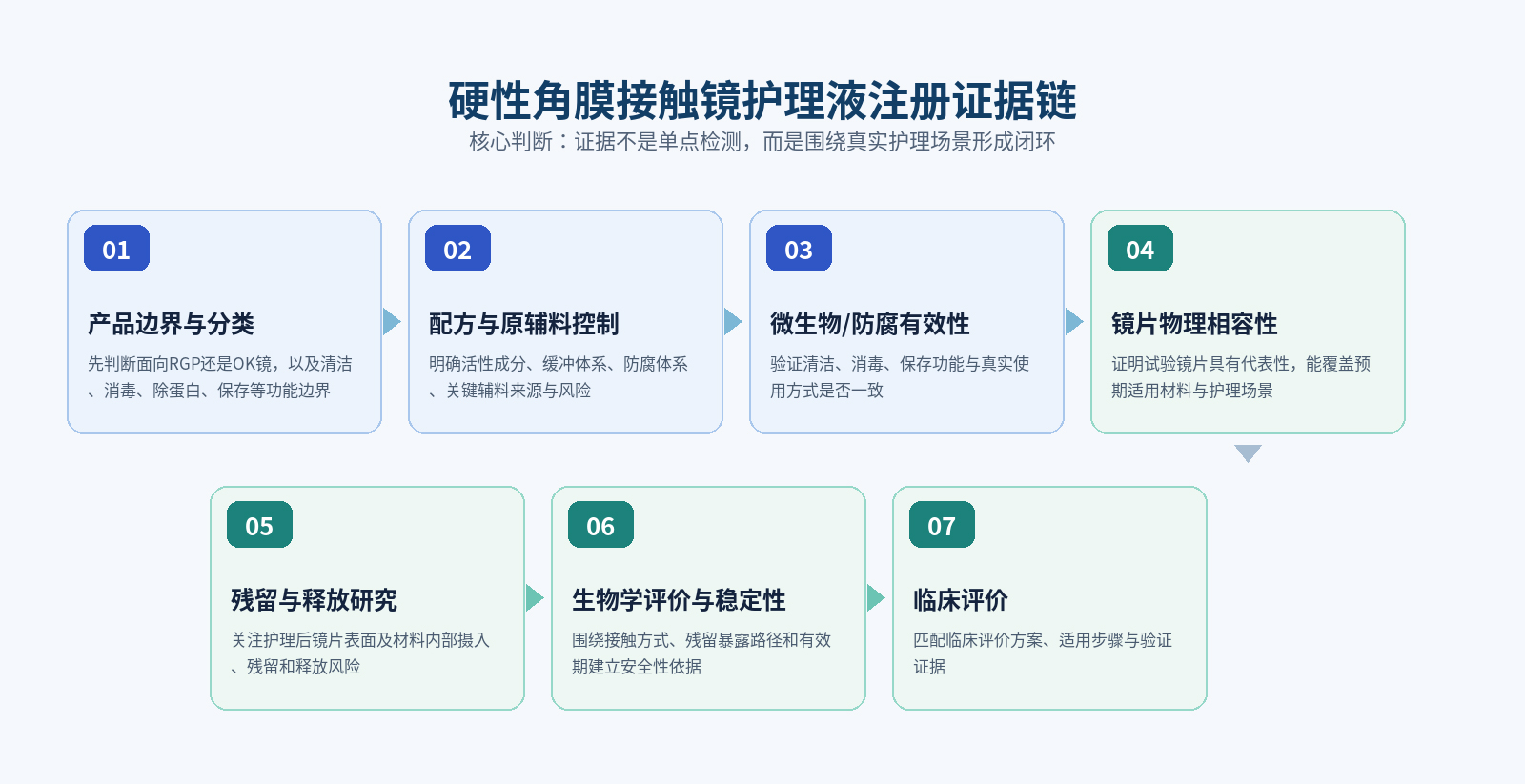
Per current official regulatory requirements, contact lens care products fall under a mature regulatory system. The Guidance for Registration Review of Contact Lens Care Products (Revised 2023) is included in NMPA's published guideline catalogue. While contact lens care products are listed in the Catalogue of Medical Devices Exempted from Clinical Evaluation, contact lens lubricants are excluded, and care products for orthokeratology rigid gas permeable lenses are explicitly ruled out from the catalogue's coverage. Therefore, care solutions for standard RGP lenses and those for OK lenses cannot adopt identical clinical evaluation pathways.
Three core issues shall be clarified at project kickoff: first, whether the product is intended for conventional rigid contact lenses or orthokeratology lenses; second, whether the product features single functions such as rinsing, cleaning or protein removal, or compound functions including disinfection and storage; third, whether the formulation contains novel ingredients absent from marketed counterparts or involves major adjustments in active ingredient concentration, packaging system or claimed functions. Ambiguous product definition will lead to repeated revisions in formulation verification, clinical evaluation and registration route confirmation.
The standard system for contact lens care products is not merely abstract compliance with specified standards. The YY 0719 series standards cover core items including general requirements, microbiological specifications, test methods, physical compatibility between contact lenses and care solutions, shelf-life investigation and biocompatibility evaluation. Instead of focusing on isolated pass/fail test results, reviewers examine whether a complete traceable and mutually supportive data package aligned with practical clinical usage has been established.
Most project teams focus on whether clinical trials are mandatory for rigid contact lens care solution registration. A prudent judgment relies on product definition and supporting evidence instead of a blanket conclusion. Conventional RGP care solutions with mature marketed counterparts, stable ingredients and fixed application scope can be prioritized for clinical exemption or simplified evaluation. In contrast, products for OK lenses, containing novel ingredients with unique functional mechanisms or upgraded claimed performance shall be planned with sufficient clinical evidence in advance.
Existing review practices indicate differentiated clinical evaluation requirements for ophthalmic care products. Products with complicated risk profiles, distinctive action principles or application modes require clinical data obtained under actual usage conditions to verify safety and effectiveness. In short, clinical evaluation is not a yes-or-no option; evidence level shall match product risks, functional claims and practical usage scenarios.
Instead of assuming clinical exemption upon project initiation, teams shall complete pathway assessment early: specify product positioning, list all differentiating items, distinguish items verifiable via non-clinical tests from those requiring adequate clinical data. Early assessment helps control registration cycle and cost effectively.
In accordance with published review standards and practical project experience, frequent obstacles in rigid gas permeable (RGP) lens care solution registration rarely stem from single failed test items but insufficient cross-support among technical documents. Apart from finished product characteristics, reviewers also assess raw material management, production environment control, manufacturing consistency, packaging compatibility and shelf-life data to guarantee consistent product quality post-launch.
01 Confirm Product Definition First Confirm applicable scenarios for RGP/orthokeratology lenses, functional combinations, new ingredients or special product claims. |
02 Build Evidence Roadmap Upfront Integrate formulation, microbiology, compatibility, residue test, biocompatibility evaluation and IFU requirements into one logical framework. |
03 Define Clinical Evaluation Route Subsequently Evaluate clinical trial exemption feasibility for mature predicate products; arrange sufficient clinical evidence at early stage for orthokeratology lens-related products or items with unique working mechanisms. |
04 Advance Documentation and QMS Simultaneously Coordinate preparation of registration dossiers, process stability verification, raw material control, packaging consistency and post-market quality management plans. |
Projects targeting orthokeratology lens application, containing special disinfectant ingredients or claiming enhanced performance require early confirmation of regulatory classification, applicable lens scope, residue hazards, compatibility research and clinical evaluation strategy. Supplementing test data after supplementary notice is generally inefficient for such products.
The links below are all publicly available documents published on the official websites of NMPA and CMDE.
• Appendix: Catalogue of Medical Devices Exempted from Clinical Evaluation (2025 Version)
• Guidance for Technical Review of Contact Lens Care Products (Revised 2023)
• List of Current Technical Review Guidelines for Medical Device Registration (as of May 31, 2025)
• YY 0719.2-2009 Ophthalmic Optics – Contact Lens Care Products – Part 2: Fundamental Requirements
• Technical Review Report for Rigid Contact Lens Care Disinfector
Conclusion: Successful registration of rigid gas permeable (RGP) lens care solutions relies not merely on a qualified formulation with testable indexes, but on establishing a complete reviewable evidence loop covering product definition, lens compatibility, residual substance risks, clinical evaluation route and IFU consistency based on practical daily care procedures. Deda Medical provides full-cycle services including preliminary registration route analysis, research protocol design and dossier compilation for ophthalmic device registration, clinical evaluation, biocompatibility testing and QMS alignment.
Note: This article is compiled based on official regulatory documents issued by NMPA for reference only. Customized registration plans shall be formulated in accordance with specific product features and latest regulatory rules, and proactive communication with competent authorities is recommended at critical project milestones.